




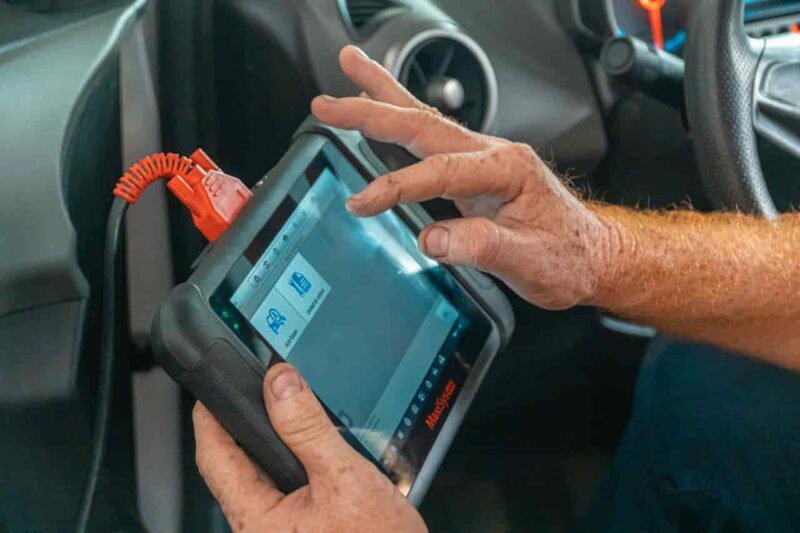
When the check engine light comes on, one of the first things many drivers do is connect an OBD-II scanner. The scanner may display a diagnostic trouble code, or DTC, such as P0300, P0171, or P0420. These codes help identify the vehicle system that may have detected a problem.
Modern vehicles use onboard diagnostic systems to monitor engine and emissions-related components. Generic OBD-II codes generally use a five-character format beginning with a letter followed by four numbers. The EPA explains that generic P0-series codes are standardized so they can be used across vehicle manufacturers.
Understanding common engine trouble codes can help drivers decide whether a problem requires immediate attention or further diagnosis.
P0300: Random or Multiple Cylinder Misfire
P0300 is one of the most recognizable engine trouble codes. It generally indicates that the engine computer has detected random or multiple-cylinder misfires.
A misfire occurs when combustion does not happen correctly inside one or more cylinders. Common causes include worn spark plugs, defective ignition coils, fuel delivery problems, vacuum leaks, or other engine-related issues.
Drivers may notice rough idling, engine shaking, hesitation, reduced acceleration, or poor fuel economy.
If the check engine light is flashing while the engine is running poorly, the vehicle should be inspected promptly. Continued operation with a serious misfire can potentially cause additional damage to the emissions system.
P0301–P0308: Cylinder-Specific Misfire Codes
Codes such as P0301, P0302, P0303, and P0304 identify a misfire detected in a specific cylinder. Later numbers can identify additional cylinders depending on the engine configuration.
For example, P0301 generally points toward cylinder number one, while P0302 points toward cylinder number two.
Possible causes include a bad spark plug, ignition coil problem, fuel injector issue, wiring fault, vacuum leak, or mechanical engine problem.
A technician should diagnose the underlying cause rather than simply replacing parts based on the code.
P0171: System Too Lean
P0171 means the engine is running with a lean air-fuel mixture on Bank 1. In simple terms, the engine computer has detected a condition where there may be too much air or insufficient fuel.
Potential causes include vacuum leaks, intake leaks, dirty or malfunctioning airflow sensors, fuel delivery problems, or other issues affecting the air-fuel mixture.
Symptoms can include rough idling, hesitation, poor acceleration, and reduced fuel economy.
Because several different problems can trigger this code, a proper diagnosis is important before replacing expensive components.
Also Read: Roof Replacement Financing: Guide
P0420: Catalyst System Efficiency Below Threshold
P0420 is associated with catalytic converter efficiency on Bank 1. The vehicle’s diagnostic system uses oxygen sensor information to monitor catalyst performance.
A P0420 code does not automatically mean that the catalytic converter needs to be replaced. Other problems, including exhaust leaks, oxygen sensor issues, or engine performance problems, can contribute to the code.
EPA materials identify P0420 through P0439 as catalyst-related diagnostic trouble codes.
A technician should investigate the entire system before installing a replacement catalytic converter.
P0455: EVAP System Large Leak
P0455 indicates a large leak in the evaporative emissions system. The EVAP system helps control fuel vapors from the fuel tank and prevents them from escaping into the atmosphere.
A loose or improperly sealed gas cap can sometimes contribute to an EVAP-related warning. Other possible causes include damaged hoses, leaking components, or problems with EVAP valves.
EPA data identifies P0455 as an evaporative emission system large-leak code and shows that EVAP leak codes are among commonly observed diagnostic codes.
If the vehicle drives normally but the check engine light appears, the problem may not immediately affect drivability. However, it should still be diagnosed.
P0440 and P0442: EVAP System Problems
P0440 generally indicates an evaporative emission control system malfunction, while P0442 commonly indicates a small EVAP leak.
These codes may result from loose fuel-system components, damaged vapor lines, defective valves, or other EVAP problems. EPA documentation lists P0440 as an EVAP system malfunction and P0442 as a small EVAP leak code.
Finding a small EVAP leak can sometimes require specialized diagnostic equipment, such as a smoke machine.
P0128: Coolant Temperature Below Thermostat Regulating Temperature
P0128 generally indicates that the engine is not reaching its expected operating temperature within the required conditions.
A faulty thermostat is a common possibility, although coolant temperature sensor problems or other cooling-system issues can also contribute.
Drivers may notice poor cabin heat, longer warm-up times, reduced fuel economy, or a check engine light.
A technician should verify coolant level and temperature readings before replacing the thermostat.
How to Diagnose Engine Trouble Codes
An OBD-II code should be treated as a diagnostic starting point rather than a guaranteed list of parts that need replacement.
A mechanic may inspect live sensor data, wiring, vacuum lines, fuel pressure, ignition components, exhaust components, and other systems depending on the code. The EPA notes that diagnostic checks can include examining trouble codes, vacuum hoses, ignition components, fuel systems, and other engine-related systems when investigating vehicle problems.
It is also important to check whether a vehicle has an outstanding emissions-related recall. The EPA provides a recall search for certain light-duty vehicles and recommends confirming recall information with the manufacturer or dealership.
Should You Drive With an Engine Trouble Code?
It depends on the code and the vehicle’s symptoms.
A car with a steady check engine light and no noticeable performance problems may sometimes be driven temporarily while an appointment is arranged. However, severe shaking, loss of power, overheating, unusual noises, smoke, or a flashing check engine light should be treated more urgently.
Ignoring an engine problem can allow a relatively small issue to become a more expensive repair.
Final Thoughts
Common engine trouble codes such as P0300, P0301, P0171, P0420, P0455, P0442, and P0128 can provide valuable information about potential vehicle problems. However, an OBD-II code does not always identify the exact failed component.
The best approach is to use the code as a starting point for diagnosis. Checking related components, testing sensors and systems, and reviewing the vehicle’s service information can help identify the actual cause.
For additional information about vehicle diagnostics and emissions systems, drivers can consult the U.S. Environmental Protection Agency’s vehicle resources.
